I don’t know why, but I’ve always been a little overly-obsessed with backups. It is no doubt the most unsexy industry in the world, but something about ensuring all the i’s are dotted and t’s crossed for data recovery gives me joy.
In September I shipped a product I’ve worked on on-and-off for almost 5 years: backupOK
I registered this domain back in 2022, and I’ve run a “personal” version of this with alerting, but never actually gotten over the hump to productize it. Although building a simple version of this “for yourself” is now trivial with an LLM, monitoring/alerting is probably one of those things that everyone should use a “third-party” for - to ensure your monitoring isn’t silently failing alongside the thing it’s monitoring!
I have a few other tools I’m working on for this too, taking sort of the unix philosophy of “do one thing well” for each type of thing versus a monolithic “observability stack”.
So what’s backupOK? Simply: you define the steps to recover your backup and verify it’s up-to-date (recency of files or database values etc). This shifts the monitoring away from “did my backup script complete” to instead “is my backup data actually in-tact as I expect it”. And then it gets run automatically every day.
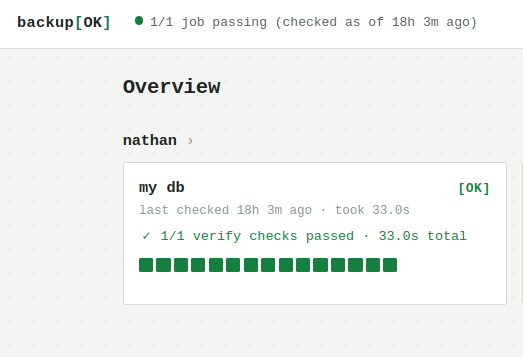
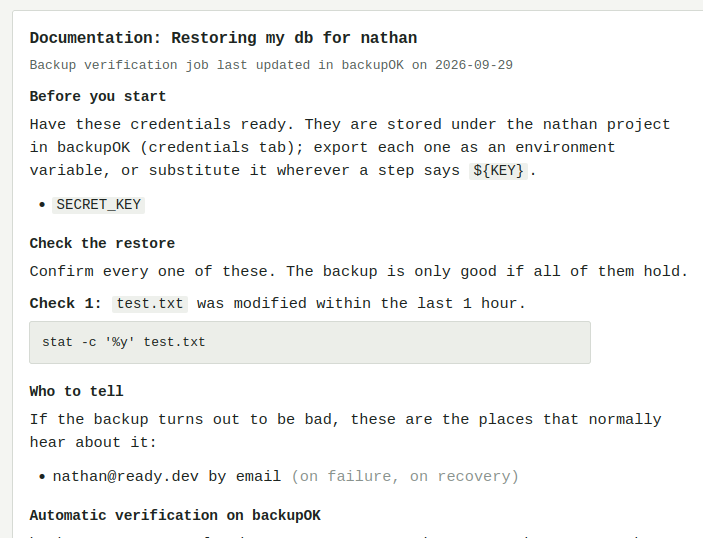
One thing I learned when building this for my own backups years ago is that having a verifiable recovery script is the most accurate documentation for actual disaster recovery situations, since it is (assuming the test is passing!) by definition up-to-date and works.
So alongside the automatic test runner, backupOK also provides the steps in English (in the UI and as markdown to copy elsewhere) as an added “insurance” policy (and peace-of-mind) around backup recovery. An externally hosted set of recovery steps that you can trust when you need it most is surprisingly compelling.
Excited to have this live for real! Everyone has backups, everyone should be testing their backups, hit me up if you want help using it.